Secure your digital wealth.
Secure your digital inheritance.
If your money, content, or business lives online,
identify the risks that could prevent your family from accessing what you leave behind.
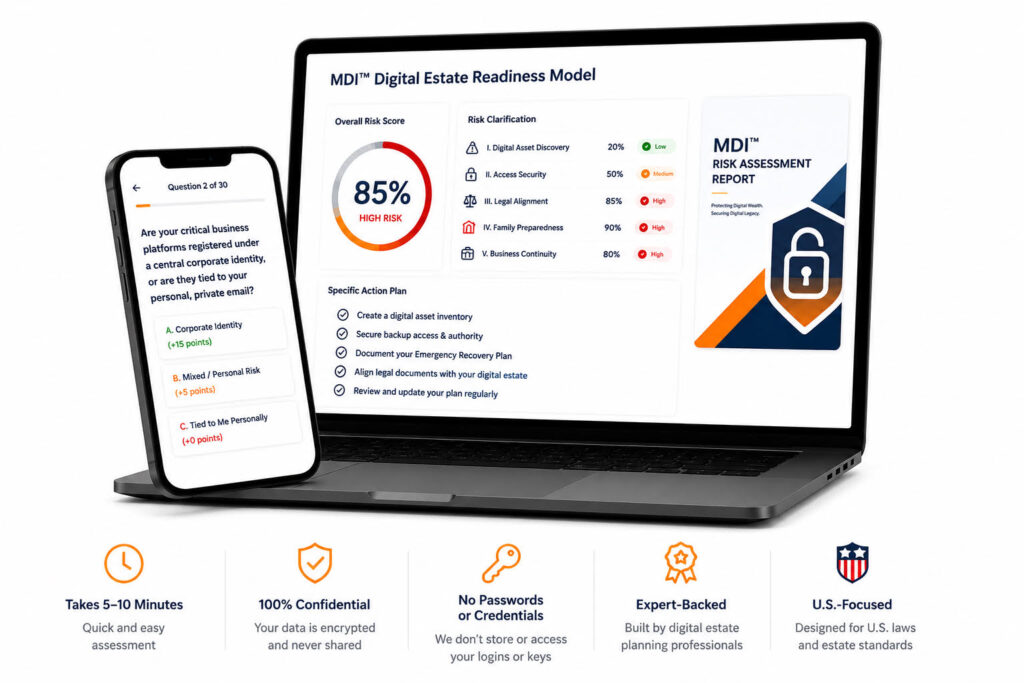
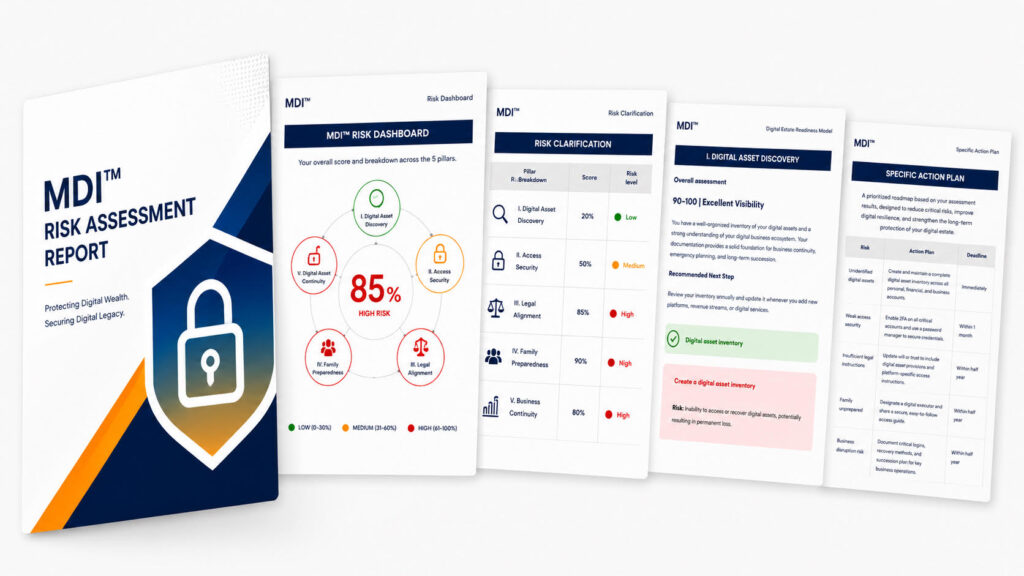
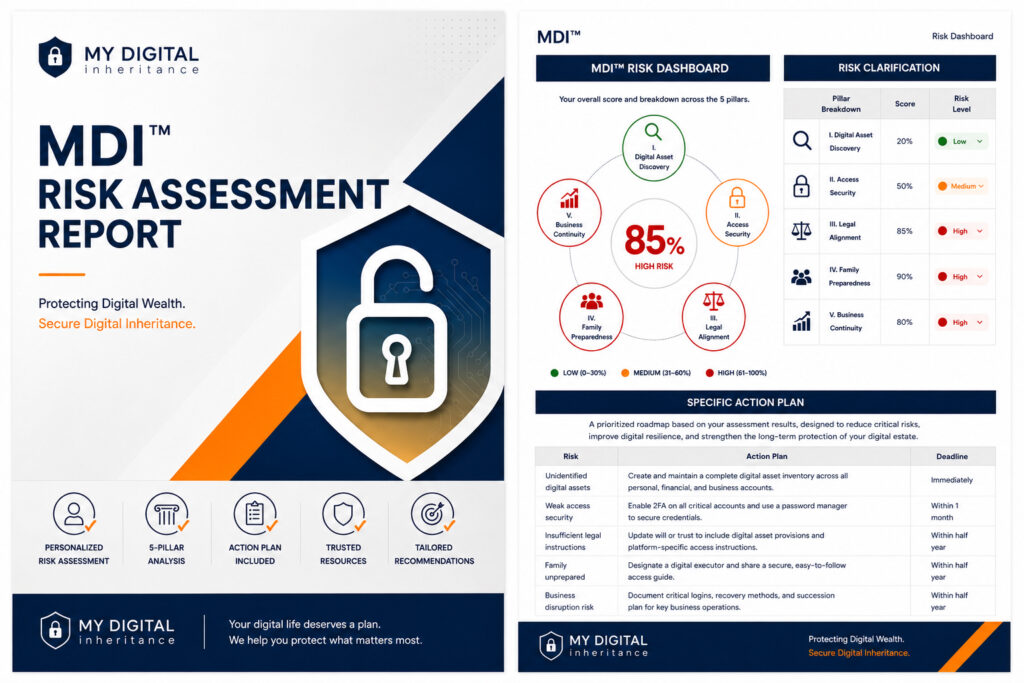
MDI™ Risk Assessment Report
✔ Personalized risk score across 5 key pillars
✔ Prioritized action plan
✔ Family access & recovery guidance
✔ Platform-Specific Guidance
✔ Recommended security improvements
79$

Take Assessment
Answer questions about your digital life.

Get Your Score
See your digital legacy score and
key risk areas.

Get Your Report
Receive your personalized report and take action with confidence.
Frequently Asked Questions
Why can’t family members simply access accounts after death?
Because access depens on login credentials, two-factor authentication, secure tools (like password manager) and legal authorization (such as will), family member cannot simply access accounts after death.
What happens to my online business and content if something happens to me?
The MDI™ Risk Assessment Report identifies vulnerabilities, prioritizes findings, and provides practical recommendations for improving digital estate readiness.
Websites, social media accounts, ad revenue, subscriptions, and digital products may remain active, but inaccessible. Income streams can be lost, content can become unmanaged, and platforms may eventually restrict or shut down accounts due to inactivity. Without proper access, even valuable digital assets can disappear or lose their value over time.That’s why secure access, backup systems, and clear ownership planning are critical.
What happens to crypto assets if no one has access?
Crypto assets are one of the most at-risk parts of your digital legacy.
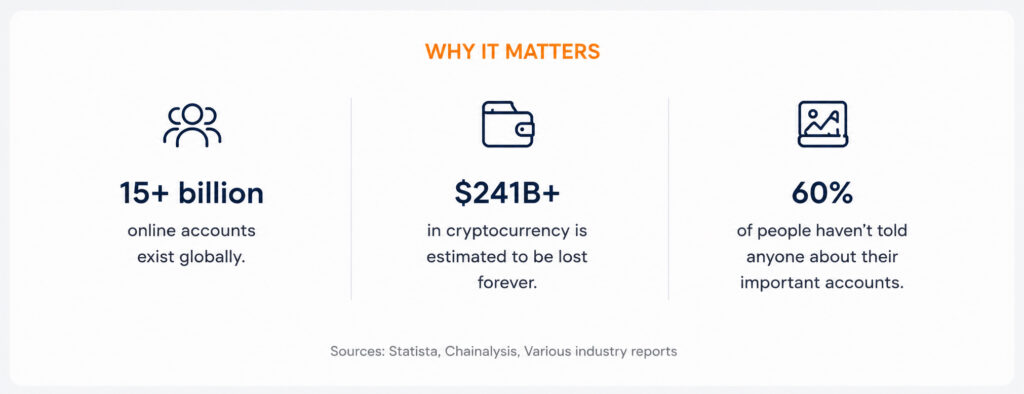
Unlike traditional financial accounts, crypto wallets cannot be recovered through customer support, identity verification, or legal requests. If private keys, seed phrases, or access credentials are lost, there is no recovery process ever. This means that if no one has access, your assets are permanently locked and effectively disappear. Billions of dollars in cryptocurrency are already considered lost for this exact reason. Without risk assessment, even high-value portfolios can become completely inaccessible overnight.
What options exist to manage digital accounts after death?
Digital platforms offer limited built-in options, such as legacy contacts (e.g. Google, Facebook), account memorilization or deletion and inactivity settings. A more reliable approach is to combine dedicated tools: use a secure password manager to store and share access credentials, store important files and documents is encrypted cloud storage, and add an extra layer of protection with a VPN when managing sensitive data.
What is the “gold standard” for securing my own digital legacy?
Maximum protection requires a three-pillar system that bridges the gap between technology and the law:
A secure digital legacy requires three key elements:
- Password manager – stores and shares access securely
- Platform settings – enable built-in legacy features (Google, Apple)
- Legal authorization – include digital assets in your will
Together, these ensure your accounts stay both accessible and protected.
Why is a Digital Estate Risk Assessment important, and do I need any technical knowledge to set it up?
A digital estate risk assessment helps identify vulnerabilities that could affect access to your accounts, online income, digital assets, and business operations. Many people assume their family will be able to access everything when needed. In reality, platform settings, account security measures, and missing instructions can create unexpected barriers.
The good news: you don’t need legal or technical expertise to get started. The MDI™ Readiness Check helps identify key areas requiring attention, while the MDI™ Risk Assessment Report provides personalized findings, recommendations, and practical next steps designed to improve your digital estate readiness.